AI Dealership Advertising Has Gone Mainstream
· AutoDealerAudio
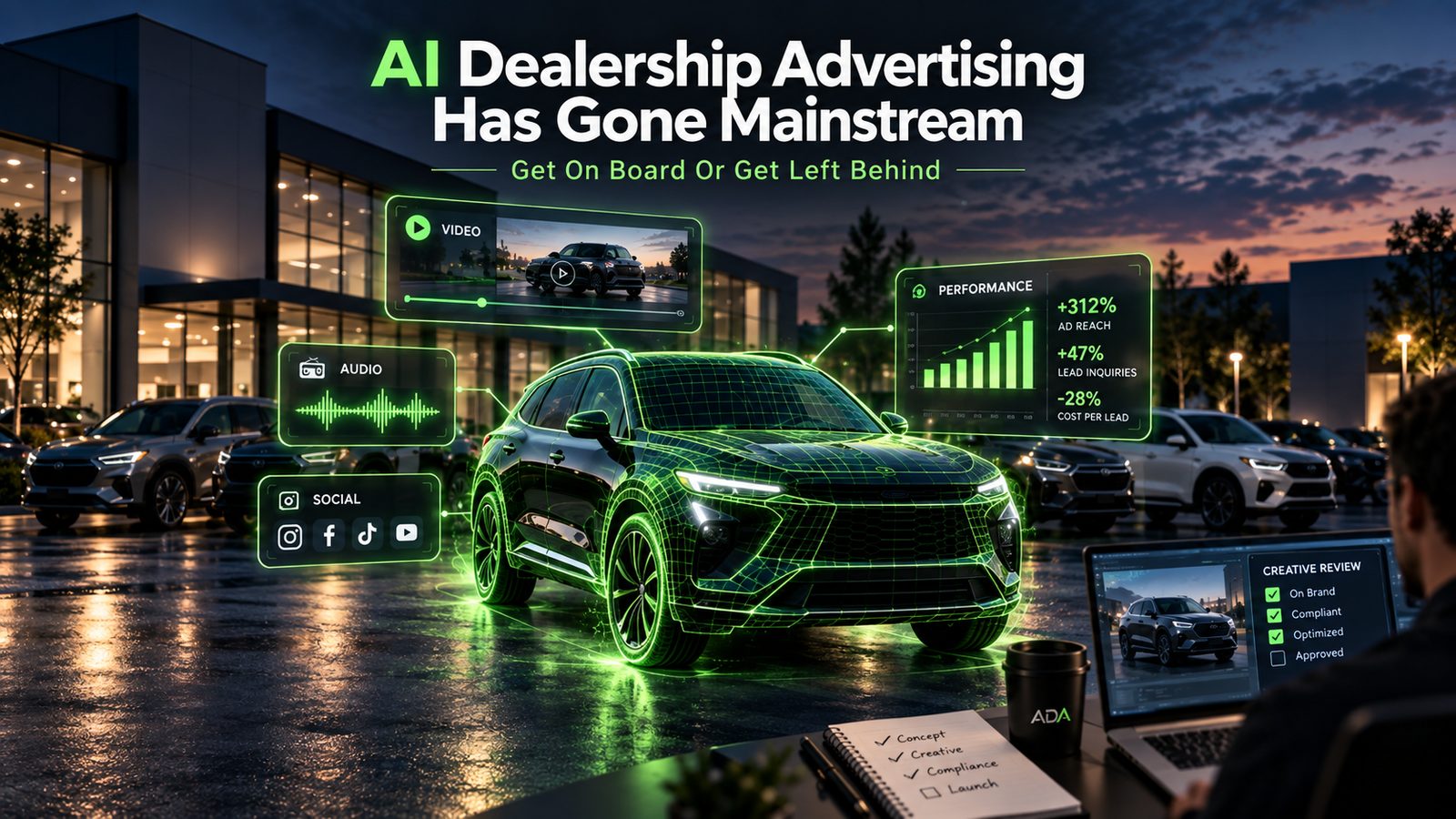
There is a version of this conversation that happened in every dealership in the country in the 1990s, about whether the store really needed a website. The dealers who moved early did not win because they were visionaries. They won because everybody else waited.
AI is not a side story in the economy — it is the story
According to Google, roughly 30% of last year's United States GDP growth was directly linked to artificial intelligence: the data centers, the chips, the software, and the productivity it unlocked inside ordinary businesses. Whatever you think of the hype cycle, a technology carrying that share of national growth is not a fad waiting to pass. It is infrastructure, and it is being installed right now.
Retail automotive is downstream of that, the same way it was downstream of the internet, of digital retailing and of connected TV. The question for a dealer principal is no longer whether AI touches their advertising. It is whether they are using it deliberately or whether their competitor across town is using it against them.
The national brands already crossed this line
AI-generated and AI-assisted creative has been running in the national spotlight — in primetime broadcast, in big-game ad breaks, and in the always-on social feeds of household brands. Major agencies now build AI into the standard pipeline for concepting, storyboards, visual generation, voice and rapid versioning. It is no longer an experiment that gets a press release; it is the way the work gets made.
That matters to a dealership for one uncomfortable reason: consumer expectations are set nationally and judged locally. Your spot does not air in a vacuum. It airs between commercials produced with the full weight of that pipeline. A static photo montage with a price slapped on it does not read as "thrifty" to a shopper. It reads as "unserious."
What AI car dealership commercials actually look like
There is a myth that AI advertising means typing a sentence and airing whatever comes out. Anyone who has tried it knows better. Raw generative output has the same relationship to a finished commercial that raw footage has to a finished edit: it is the beginning of the work, not the end.
A finished AI-enhanced dealership commercial still requires a copywriter who understands automotive retail, a director making choices about pacing and emotion, an editor building the cut, a colorist, and an audio engineer mastering the mix to broadcast standards. What AI removes is the part that historically priced dealerships out of great creative: the production day. No crew call, no location fee, no weather delay, no reshoot when the inventory changes.
For a closer look at where AI holds up and where it still fails, read Are AI-Generated Car Dealership Video Ads Any Good? and the side-by-side in AI Video Ads vs. Traditional Dealership Video Production.
AI automotive radio ads: the quiet advantage
Radio and streaming audio is where AI pays off fastest for a store, because audio creative is the thing dealerships neglect most. Most stores run one spot per quarter, long after the offer inside it expired, because rewriting and re-recording felt like a production project every time.
With AI-assisted scripting and a consistent, brand-owned voice, a dealership can run a new :60 every time the offer changes, tag it for multiple stations, and keep a recognizable sound across every one of them. That is a completely different advertising posture than "the spot we cut in March." Voice consistency is its own topic — see How AI Voice Cloning Works for Dealership Advertising.
Volume is the real unlock, not cost
Dealers usually discover AI through the price tag, then stay for something else entirely: the number of pieces they can put in market. When a video no longer costs a shoot day, you stop rationing creative. You run a different spot for trucks than for compacts. You run service and parts creative instead of only new-car offers. You cut vertical versions for social instead of stretching one horizontal spot across every placement.
That is how modern platforms actually reward advertisers. Feeds and connected TV environments favor freshness and variation; a single spot repeated for six months burns out and gets skipped. Volume used to be a budget question. Now it is a workflow question.
Where AI must not be left alone
- Compliance and disclaimers. Payment terms, APR language and offer expirations get written and verified by people. Always.
- Manufacturer brand standards. Franchise stores have rules about logos, vehicle depiction and co-op requirements that a generative model does not know.
- Factual accuracy. Inventory, pricing and store details are checked against reality before anything ships.
- Broadcast finishing. Loudness mastering, aspect-ratio cuts and caption burn-in are production steps, not prompts.
Three things dealer principals should weigh today
Strip everything else away and the decision in front of a dealer principal comes down to three considerations.
- National standards, local judgment. AI-assisted creative is already running in primetime broadcast and social feeds for national brands. Consumer expectations are set nationally and judged locally, which is why a static photo montage with a price tag reads as unserious to shoppers — even in a small market.
- Volume is the real advantage. Modern platforms penalize running a single spot until it burns out and favor freshness and variation. AI removes shoot days, location fees and weather delays, so a store can scale creative across vehicle segments and the service department instead of rationing one spot per quarter.
- Human oversight is mandatory. Raw generative output is just the raw footage of advertising. Human copywriters, directors and audio engineers shape the creative, while compliance language, payment disclaimers, brand standards and inventory pricing are strictly verified by people.
Get on board now, or get left behind
Every market has one store that quietly modernizes its creative a year before everyone else, and spends that year looking dramatically bigger than it is. Then the rest of the market catches up and the advantage disappears. The only variable a dealer controls is which side of that window they are on.
The cheapest way to find out where you stand is to see your own store's creative produced this way and compare it to what you are running today. See how the plans and turnaround work on our dealership advertising services page, or request a free commercial and judge the work itself.